- Cmind AI by Weihong Zhang
- Posts
- AVGO Week: AI demand is the headline — the beat is table stakes — the guide decides | three-spike signal path ~80%
AVGO Week: AI demand is the headline — the beat is table stakes — the guide decides | three-spike signal path ~80%
Dispersion-first: right-tail clusters are tradable baskets | Top Movers (chg): ITRN +42, ASTS −39 | Expectations are repricing fast into March


John DiBenedetto & Weihong Zhang
March 02, 2026
Hi everyone — welcome to this week’s Cmind Earnings Outlook (week of March 2–6, 2026).
The heatmap is still flashing a familiar regime: dispersion > direction. The market is paying for clean guidance + margin credibility and punishing anything that widens the forward range—especially in names where AI expectations are already elevated. That’s the right frame for this week because the calendar is anchored by a classic “AI infrastructure stack”: Broadcom (AVGO).
If last week’s conversation was “NVDA as the AI central bank,” this week is the second derivative: networking + custom silicon + software margins. AVGO sits at the intersection of all three. That combination makes it an ideal hedge-fund feature—not because it’s exotic, but because it’s one of the most widely owned, most heavily modeled names in the stack.
This week’s trade map:
Macro node: AVGO — the market will trade margin trajectory + Q2 guide clarity
Right tail cluster: Industrials + select IT/Comm standouts
Left tail pocket: very low-probability micro names → gap risk + liquidity sensitivity
Feature of the Week — Broadcom (AVGO): three-spike signal path into 3/4
Earnings Release Date (Est): 2026-03-04
Consensus EPS: $1.67
Latest Cmind Beat Probability: ~80%

AVGO is an “everyone-can-talk-about-it” company—so the edge isn’t having a narrative. The edge is understanding where expectations are tightening vs widening, and what management has to say for the tape to pay the print.
This is also a clean CapEx visibility case study for 2026:
AI demand is real, but the market is grading payback.
When investors worry about AI spend, they look for throughput proof (spend → revenue → margin → cash flow).
AVGO sits inside the pipes: switching, custom ASICs, and (via VMware) software margin structure. That makes it an excellent “AI monetization plumbing” barometer.
What Cmind’s signal path is saying
AVGO’s probability started near neutral (~56% in late Dec 2025) and then traded with meaningful volatility through January (roughly ~54% to ~76%). The defining feature, though, is three sharp spikes above ~88% in early-to-mid February:
~92% around Feb 2–3 (first “major spike”)
~88% around Feb 5–6 (second spike)
~90% sustained Feb 14–18 (third spike, held multiple days)
Between spikes, the signal pulled back materially (including a quick reversal back toward the low-50s after the first spike), before reconverging and ending around ~79% heading into the March 4 event window.
This wasn’t a slow, clean ramp. It was a high-information tug-of-war where the model repeatedly detected strong positive conditions, then re-priced the distribution when conflicting inputs hit.
The fact that the signal spiked three separate times and still settles near ~80% into the print reads like persistent positive pressure, but with expectation risk still present.
In these setups, the market often separates “beat-and-go” from “beat-but-questioned” based on margin commentary + the forward range.
What the market will actually trade
Your quoted setup captures the Street’s debate well: AVGO is widely viewed as a structural AI beneficiary (backlog + networking + VMware margin structure), but the stock has also been sensitive to one thing it’s “supposed” to be great at: margins. That’s why the reaction function is likely to be dominated by:
1) AI backlog / demand durability
Any update that supports “AI demand is scaling” tends to compress dispersion.
Any ambiguity about timing, mix, or concentration tends to widen it.
2) VMware margins as a credibility anchor
Software margins are where investors look for conversion discipline (profitability that doesn’t require incremental CapEx).
3) Networking silicon + next-gen switching
This is where AVGO becomes a second-derivative AI read-through: data center build requires networking throughput.
4) Q2 guidance + margin trajectory
This is the “pay” line. If the guide tightens and margins hold, a beat is more likely to be rewarded.
If the guide widens or margin trajectory introduces uncertainty, even a beat can fade.
Call sentiment snapshot
The sentiment breakdown of $AVGO last-quarter’s earnings call supports a constructive baseline tone:
Management tone leaned strongly positive (high confidence in AI revenue growth, bookings strength, and forward outlook).
Analysts were constructive but more granular—probing non-AI recovery, mix, and backlog composition.
Sentiment supports “constructive expectations,” which means this is a high bar week: good numbers alone may not be enough if the guide isn’t clean.

AVGO checklist
Guide: does management tighten the forward range or widen it?
Margins: is the margin bridge clean (mix/VMware support) or noisy?
AI backlog: do they raise/extend the AI demand narrative with measurable proof points?
Networking: any confirmation of switching cycle strength and design wins?
Tone: confident + specific beats optimistic + vague.
Top 6 Beats / Top 6 Misses - Week of March 2, 2026)
✅ Top 6 Beats
AMRC — 95% (Industrials, Small Cap)
SATS — 95% (Information Technology, MidCap)
BILI — 94% (Communication Services, Large Cap)
ITRN — 92% (Information Technology, Small Cap)
FIZZ — 89% (Consumer Staples, MidCap)
AQN — 88% (Utilities, MidCap)
⚠️ Top 6 Misses
SLND — ~5% (Industrials, Small Cap)
CSTE — ~10% (Industrials, Small Cap)
AWRE — ~11% (Information Technology, Small Cap)
AZO — ~13% (Consumer Discretionary, Large Cap)
TRC — ~14% (Industrials, Small Cap)
BEEP — ~14% (Industrials, Small Cap)
Quick read: right tail is clean and mostly “execution premium.” Left tail is micro + idiosyncratic, where liquidity and guidance tone can create discontinuous gaps.
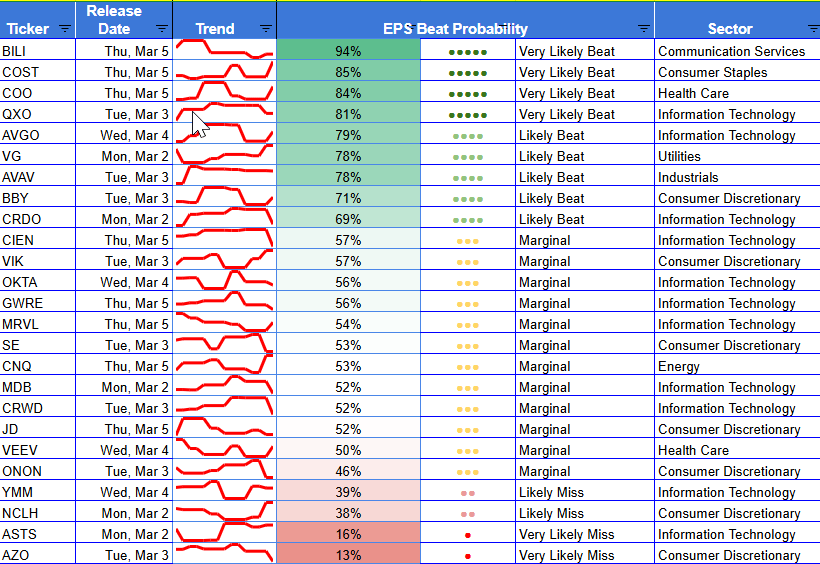
Heatmap

This board has a “two-speed” feel:
Right tail: a small set of names screens >88-95% (AMRC/SATS/BILI/ITRN/FIZZ/AQN), which is the classic signature of late-window convergence in pockets that matter.
Left tail: the lowest names are concentrated in small-cap Industrials/IT with very low probabilities (single-digit to low-teens), which are precisely the setups where gap risk dominates.
Market Cap Exposure
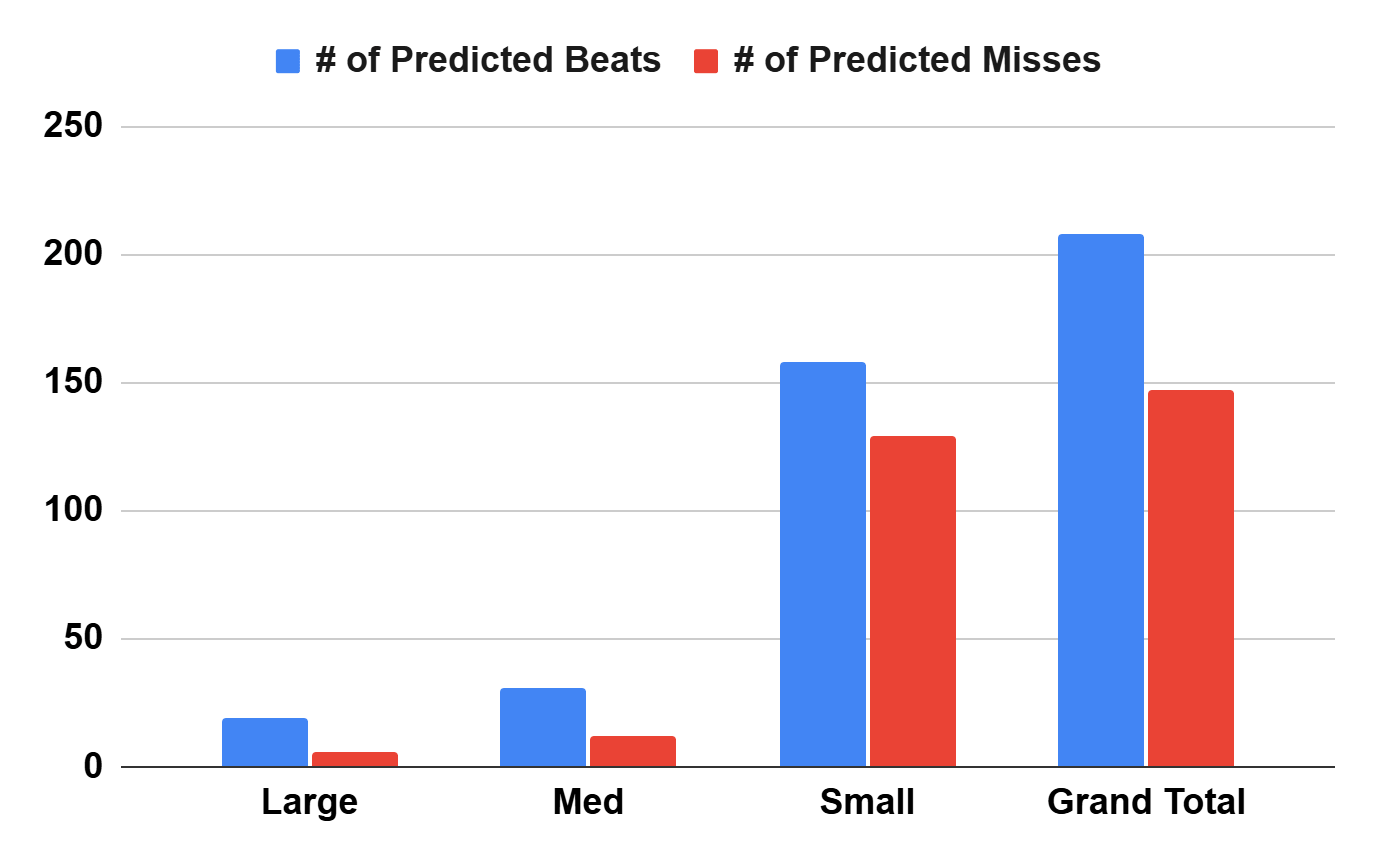
Mega / Large Cap
Large-cap signals are tradable because you can size them. The board’s large-cap standout on the right tail is BILI (~94%), while AZO (~13%) is an unusual large-cap left-tail outlier. That combination is classic “selectivity tape”: big liquidity doesn’t mean low risk—it just means the reaction can be expressed cleanly if the guide surprises.
MidCap
Mid caps are showing some of the cleanest “tight distribution” behavior this week: SATS (95%), FIZZ (89%), and AQN (88%) are high-conviction names that tend to be easier to express via basket overlays than small-cap idiosyncratic trades. Expect sharper guide sensitivity than mega caps, but still more tradable than microcaps.

Small Cap
Small caps dominate the calendar and carry the widest reaction cones. The right tail (e.g., AMRC ~95%, ITRN ~92%) looks like confidence ramps, while the left tail (SLND/CSTE/TRC/BEEP) reads like “fragility flags” where liquidity and one line of guidance can drive oversized moves.

Sector Exposure

Industrials: showing up on both tails (AMRC/JBI on the left; SLND/CSTE/TRC/BEEP on the right) → the sector is gap-prone this week and likely trades stock-specific.
Information Technology: mixed distribution with a standout right tail (SATS/ITRN), but also left-tail pockets (AWRE).
Consumer Staples: FIZZ plus other staples names lean constructive—more “visibility-on” than risk-off.
Communication Services: BILI anchors the right tail; the sector looks more selective than broad.
Top Movers (±10 pts - Week over Week)
✅ Biggest Upward Shifts
ITRN +42 pts → 92% (IT, Small)
DDL +39 pts → 62% (Consumer Staples, Small)
GEVO +39 pts → 61% (Materials, Small)
JBI +36 pts → 80% (Industrials, Small)
AMRC +36 pts → 95% (Industrials, Small)
⚠️ Biggest Downward Shifts
ASTS −39 pts → 16%
GROV −35 pts → 35%
TRC −33 pts → 14%
RPAY −33 pts → 19%
AWRE −33 pts → 11%
Interpretation: Big positive ramps occur when the model underwrites execution late in the window. Big negative resets are where the reaction cone widens—often guide sensitivity > EPS optics.
Setup for next week
As we roll forward, the market remains in a “payback timeline” regime: AI + infrastructure names get paid when guidance is specific and margins/cash flow bridges are clean. Expect dispersion to stay elevated as the calendar rotates into the next wave of prints; the best risk map will continue to be movers + tail clustering, not broad sector headlines. If AVGO confirms and guides cleanly, it supports second-derivative AI infra confidence; if it doesn’t, dispersion widens.
About the Model
Cmind AI’s EPS predictions are powered by a machine learning model built for accuracy, objectivity, transparency, and daily updates with the latest market information. We ingest over 150 variables across five data modalities—including real-time 10-Q filings, earnings transcripts, governance metrics, and peer signals—to provide early, company-specific EPS forecasts.
Our EPS signals update daily across 4,400+ U.S. stocks using a multi-input ML model (filings, transcripts, price/earnings dynamics, governance, and peer signals). The goal isn’t to predict headlines—it’s to quantify where dispersion is most likely so you can build better baskets, hedges, and sizing into catalyst windows.
📩 To learn more, contact us at [email protected].